
Our favourite lab has been selected to be a 2015 GPU Research Center “based on the vision, quality, and impact of (y)our research leveraging GPU Computing”.
A great thank to all LAB members that made it possible and to NVIDIA selection committee!
Our favourite lab has been selected to be a 2015 GPU Research Center “based on the vision, quality, and impact of (y)our research leveraging GPU Computing”.
A great thank to all LAB members that made it possible and to NVIDIA selection committee!
F. Campeotto, A. Dovier, and E. Pontelli.
A Declarative Concurrent System for Protein Structure Prediction on GPU.
Journal of Experimental & Theoretical Artificial Intelligence (JETAI).
On line since february 2015
DOI: 10.1080/0952813X.2014.993503
Abstract
This paper provides a novel perspective in the Protein Structure Prediction (PSP) problem. The PSP problem focuses on determining putative 3D structures of a protein starting from its primary sequence. The proposed approach relies on a Multi-Agent System (MAS) perspective, where concurrent agents explore the folding of different parts of a protein. The strength of the approach lies in the agents’ ability to apply different types of knowledge, expressed in the form of declarative constraints, to prune the search space of folding alternatives. The paper makes also an important contribution in demonstrating the suitability of a General-Purpose Graphical Processing Unit (GPGPU) approach to implement such MAS infrastructure, with significant performance improvements over the sequential implementation and other methods.
Cliccando sulla foto (item 18) c’è una lezione on-line sul ruolo dei giochi in AI (realizzata per il progetto flash forward 2 organizzato dalle Università di Udine e Trieste).

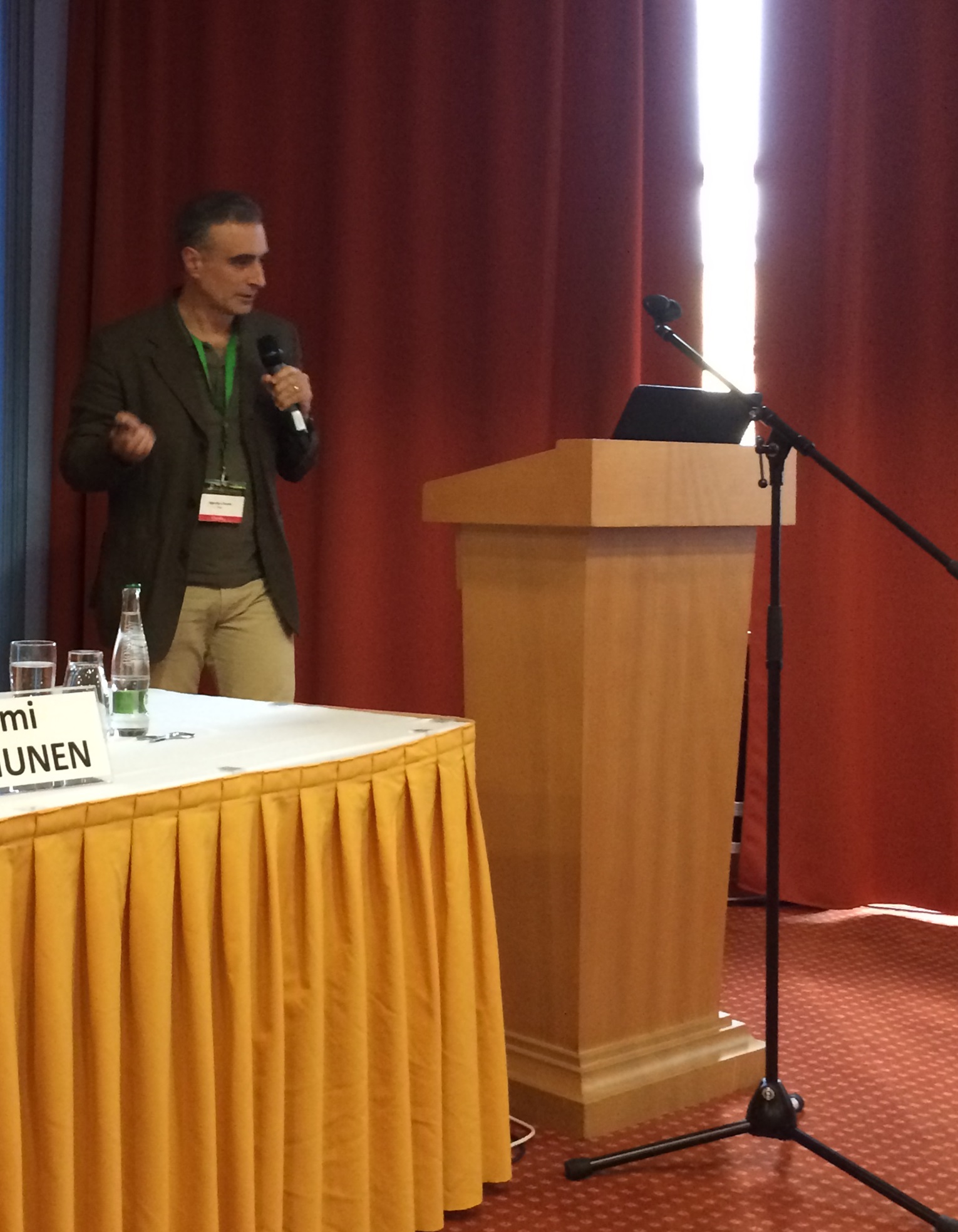
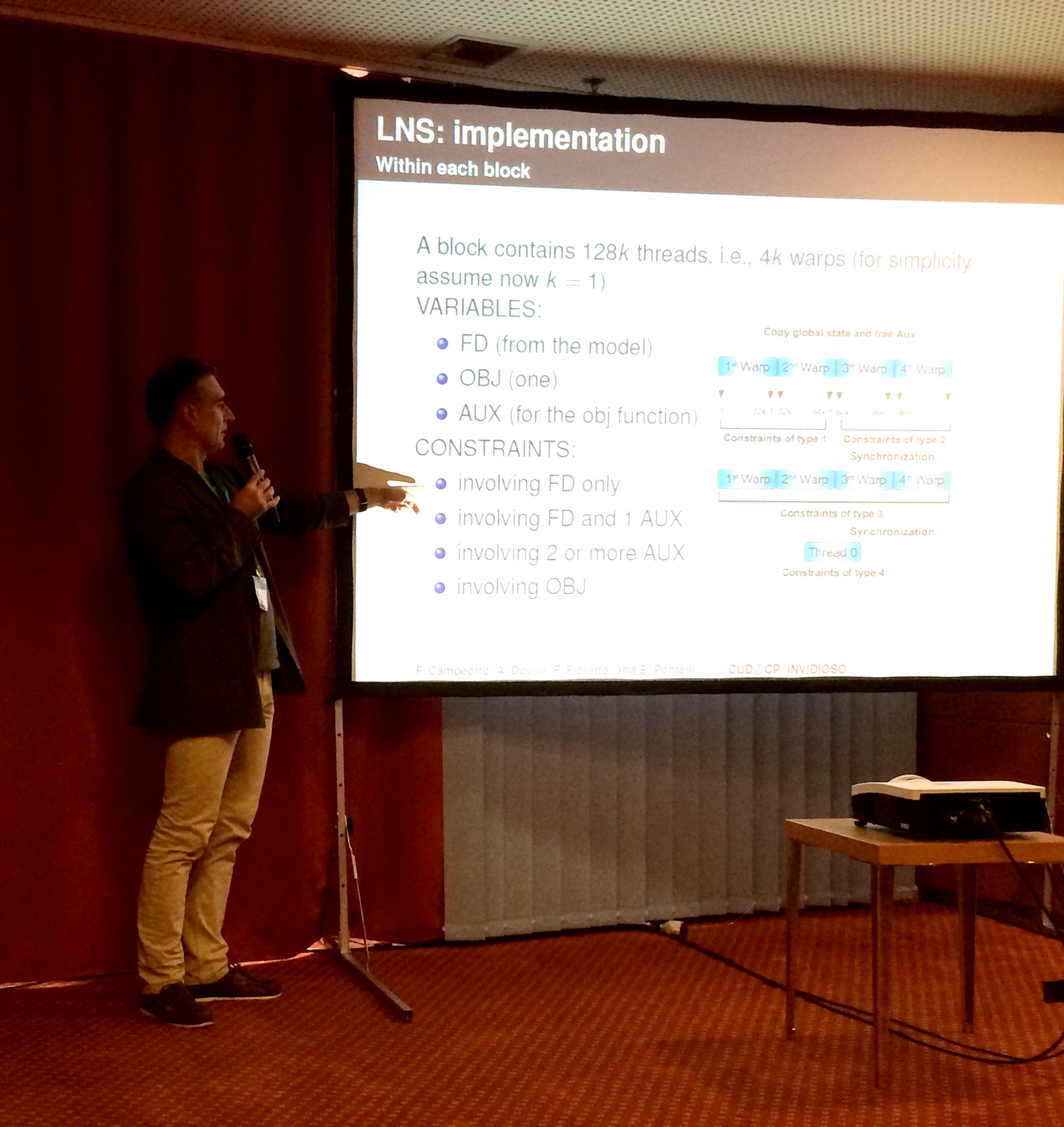
Agostino Dovier @ECAI2014. Pictures by Enrico Pontelli
The paper A GPU Implementation of Large Neighborhood Search for Solving Constraint Optimization Problems by F. Campeotto, A. Dovier, F. Fioretto, and E. Pontelli will be presented (as full paper) at ECAI 2014
ABSTRACT
Constraint programming has gained prominence as an effective and declarative paradigm for modeling and solving complex combinatorial problems. Techniques based on local search have proved practical to solve real-world problems, providing a good compromise between optimality and efficiency. In spite of the natural presence of concurrency, there has been relatively limited effort to use novel massively parallel architectures, such as those found in modern Graphical Processing Units (GPUs), to speedup local search techniques in constraint programming. This paper describes a novel framework which exploits parallelism from a popular local search method (the Large Neighborhood Search method), using GPUs.


Ferdinando Fioretto ed Enrico Pontelli non hanno bisogno del biglietto 🙂
Members of our favourite lab will be involved in the exciting SMART GRIDS project just funded by NSF. Congratulations to Enrico.
For details read: http://newscenter.nmsu.edu/10029/
The paper: Exploring the Use of GPUs in Constraint Solving, by F. Campeotto, A. Dal Palù, A. Dovier, F. Fioretto, and E. Pontelli is accepted in PADL 2014 conference http://www.ist.unomaha.edu/padl2014/ (Springer), San Diego, CA, January 22-23, 2014.
Abstract
This paper presents an experimental study aimed at assessing the feasibility of parallelizing constraint propagation|with particu lar focus on arc-consistency using Graphical Processing Units (GPUs). GPUs support a form of data parallelism that appears to be suitable to the type of processing required to cycle through constraints and domain values during consistency checking and propagation. The paper illustrates an implementation of a constraint solver capable of hybrid propagations (i.e., alternating CPU and GPU), and demonstrates the potential for competitiveness against sequential implementations.
CLPLAB is involved in two new projects with local companies:
Now, let’s work.
The paper: Protein Structure Prediction on GPU: a Declarative Approach in a Multi-agent Framework, by F. Campeotto, A. Dovier, and E. Pontelli is accepted in ICPP conference (IEEE) http://icpp2013.ens-lyon.fr/ Lyon (FR), October 2013.
Abstract
This paper provides a novel perspective in the Protein Structure Prediction (PSP) problem. The PSP problem focuses on determining putative 3D structures of a protein starting from its primary sequence. The proposed approach relies on a multi-agents approach, where concurrent agents explore the folding of different parts of a protein. The strength of the approach lies in the agents’ ability to apply different types of knowledge (expressed in the form of declarative constraints to prune the local space of folding alternatives. The paper demonstrates the suitability of a GPU approach to implement such multi-agent infrastructure, with significant improvements in speed and quality of solutions w.r.t. other methods (e.g., based on fragments assembly approaches).