
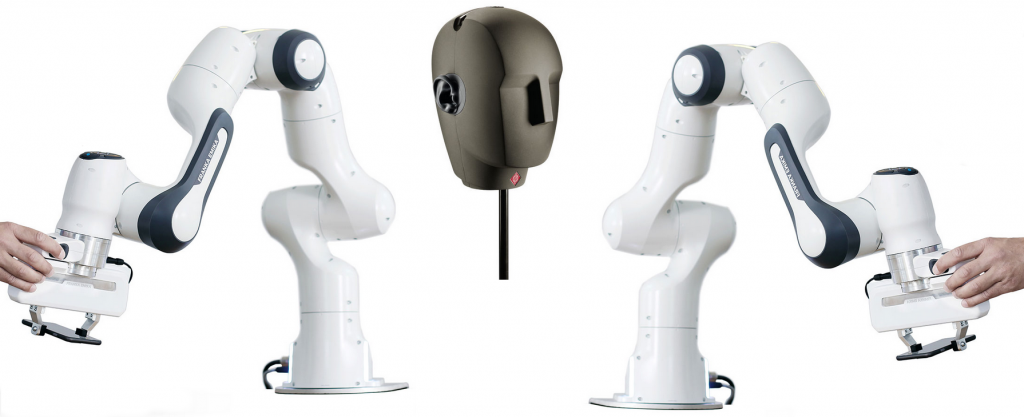
Agostino Dovier will coordinate the multi disciplinary UNIUD project
Artificial Intelligence for Human-Robot Collaboration
funded by Fondazione Friuli. The project is presented on Feb 25, 2021.
Agostino Dovier will coordinate the multi disciplinary UNIUD project
Artificial Intelligence for Human-Robot Collaboration
funded by Fondazione Friuli. The project is presented on Feb 25, 2021.
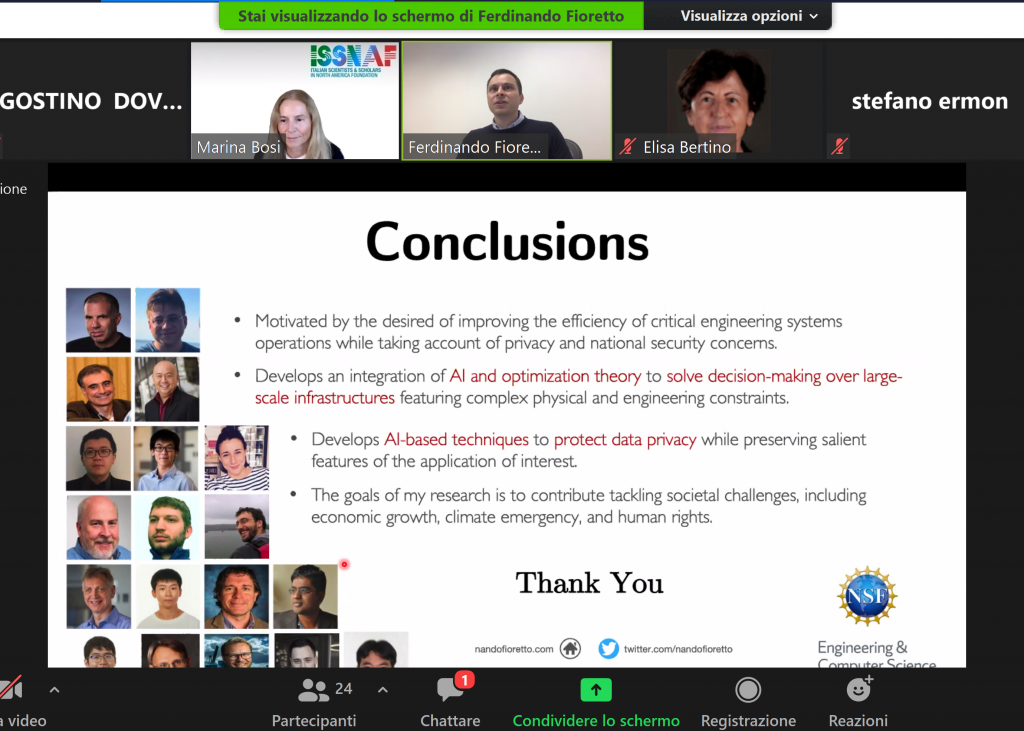
Ferdinando Fioretto, già dottorando di ricerca in Informatica presso l’università di Udine, membro del CLPLAB del DMIF, e premiato dall’Associazione Italiana di Intelligenza Artificiale per la sua tesi di dottorato valida anche come “double degree” con la New Mexico State University, ora assistant professor presso Syracuse University, è uno dei tre finalisti per il prestigiosissimo “Mario Gerla Award for Young Investigators in Computer Science”. Nando ha presentato la sua ricerca venerdì scorso all’evento organizzato dall’Issnaf – Italian Scientists and Scholars in North America Foundation. Il vincitore sarà annunciato a breve, ma comunque vada tantissimi complimenti a Nando per quello che ha fatto e sta facendo, siamo orgogliosissimi di lui!
PS Per avere una idea di chi fosse e dell’impatto scientifico di Mario Gerla, nativo di Arona, in Piemonte, e distinguished Professor e Chair of the Department of Computer Science della University of California, Los Angeles, mancato nel 2019, si consiglia di dare una occhiata alla sua entry google scholar
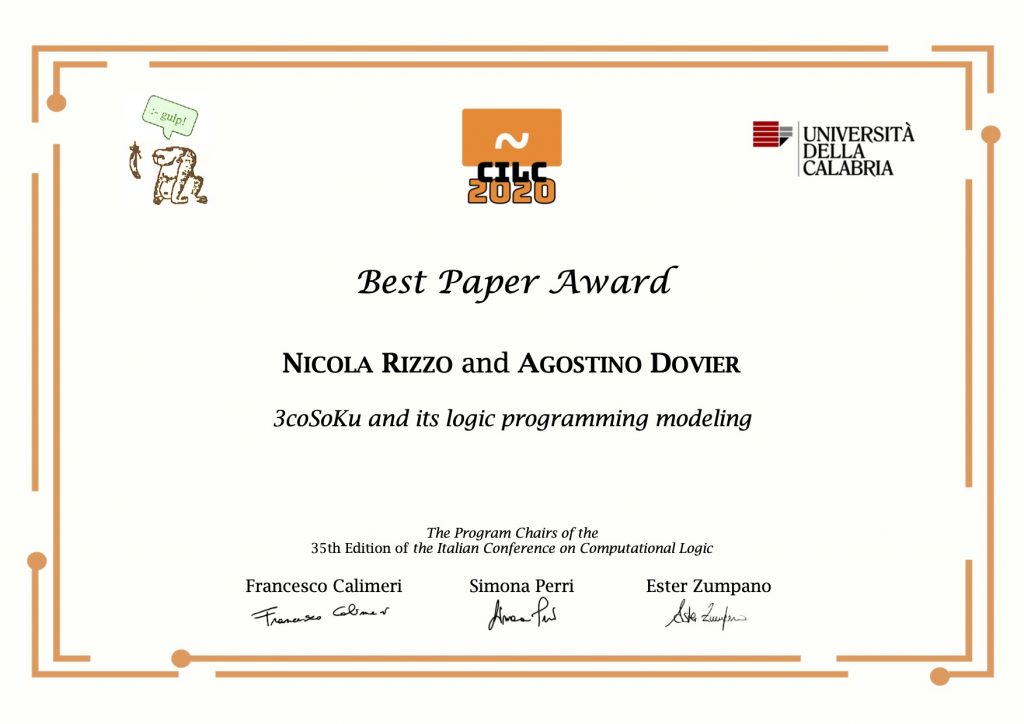
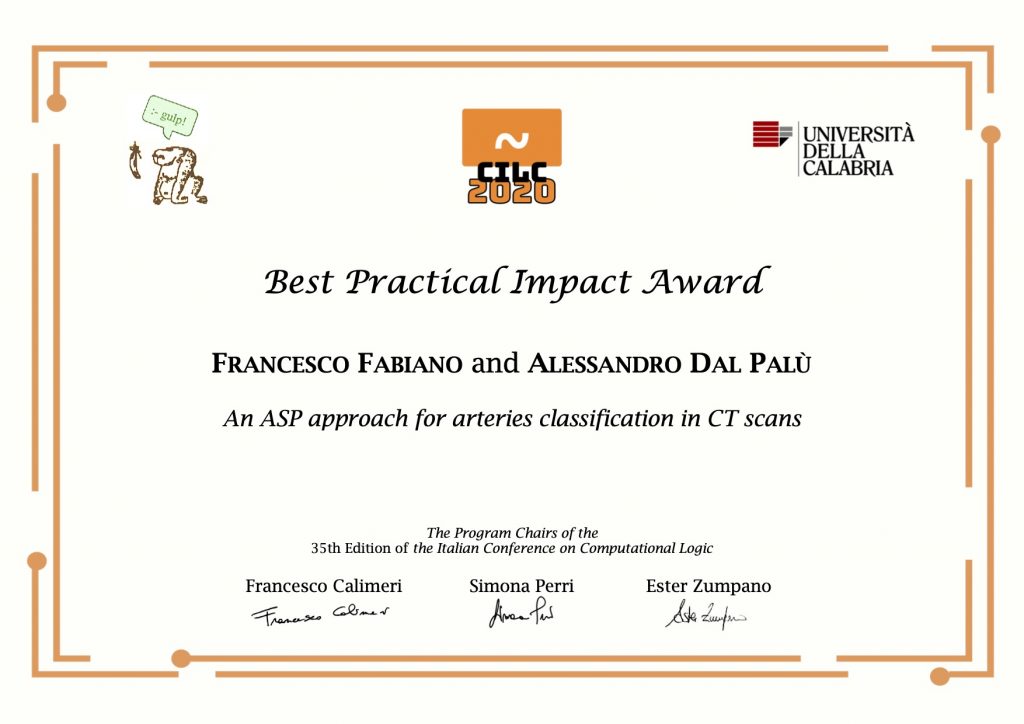
Il CLPLAB vince entrambi i premi messi in paio dagli organizzatori del convegno CILC2020, 35-esimo convegno dell’associazione di programmazione logica GULP. In particolare:
Best Paper award goes to:
Best Practical Impact award goes to:
Congratulazioni ai miei studenti (ed ex) Nicola, Francesco, e Alessandro.
Andrea Formisano has been elected as one of the seven members of the Executive Commitee of the Association for Logic Programming. Congratulations to Andrea for this role that is added to his role as vice-president of the Italian Association for Logic Programming.
Agostino Dovier, Andrea Formisano, Flavio Vella
In Revised Selected Papers of Declarative Programming and Knowledge Management – Conference on Declarative Programming, DECLARE 2019, Lecture Notes in Computer Science 12057, Springer 2020, pages 3-23.
ABSTRACT Answer Set Programming (ASP) has become the paradigm of choice in the field of logic programming and non-monotonic reasoning. With the design of new and efficient solvers, ASP has been successfully adopted in a wide range of application domains. Recently, with the advent of GPU Computing, which allowed the use of modern parallel Graphical Processing Units (GPUs) for general-purpose computing, new opportunities for accelerating ASP computation has arisen. In this paper, we describe a new approach for solving ASP that exploits the parallelism provided by GPUs. The design of a GPU-based solver poses various challenges due to the peculiarities of GPU in terms of both programmability and architecture capabilities with respect to the intrinsic nature of the satisfiability problems, which exposes poor parallelism.
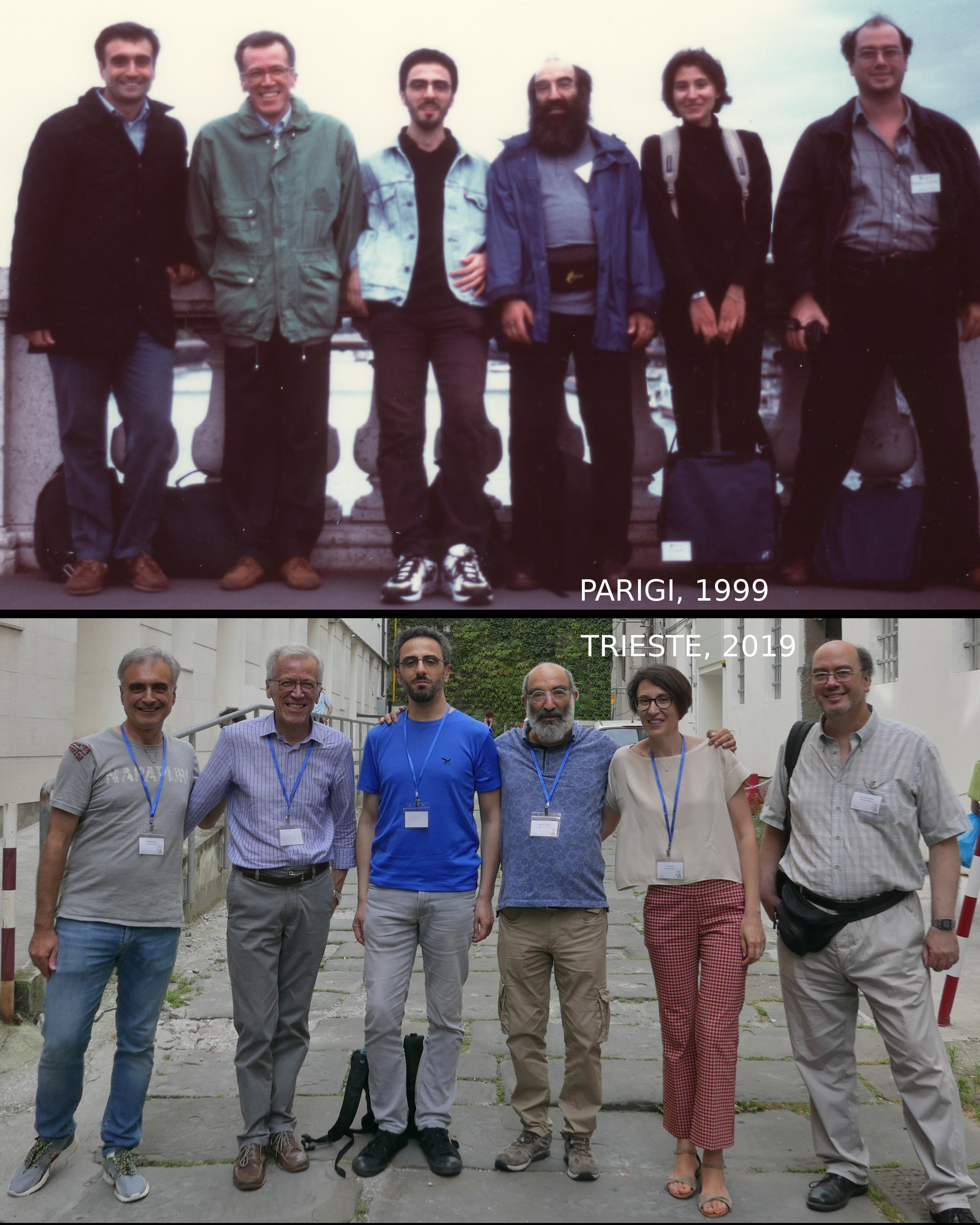
Si è svolto a Parma il 3 e 4 giugno il primo meeting di progetto INDAM/GNCS 2019 “Logic Programming for early detection of pancreatic cancer”. Mettiamocela tutta per aiutare la ricerca sul cancro!
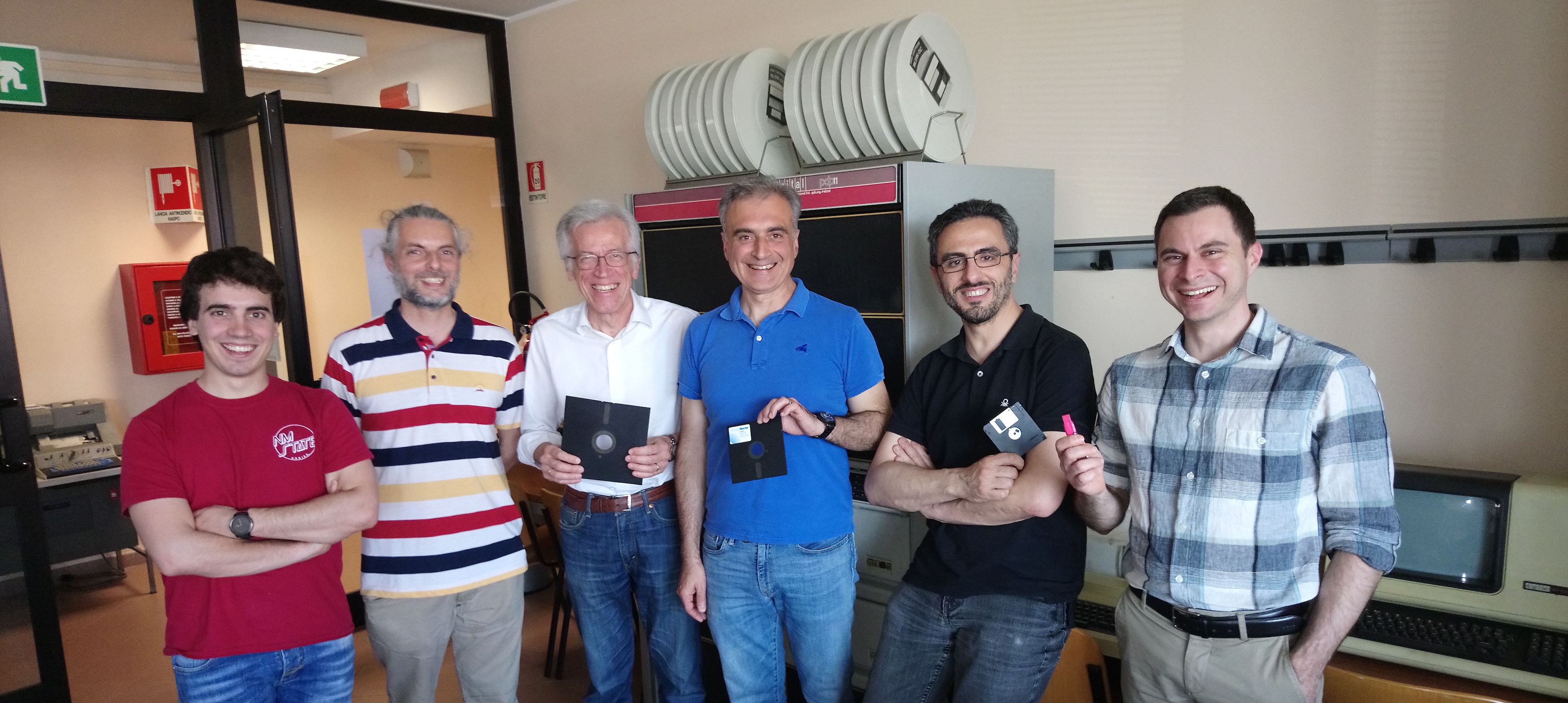
Il 14 Maggio 2019 siamo stati invitati a presentare i nostri risultati di ragionamento automatico in sistemi multiagente applicati alle smat grid energetiche al convegno organizzato dall’academy of sciences for the developing world http://festivalsvilupposostenibile.it/ I lucidi della presentazione sono di seguito.

Distributed Multi-Agent Optimization for SmartGrids and Home Automation. Ferdinando Fioretto, Agostino Dovier, Enrico Pontelli. IA 12(2):67-87 (2018)
Abstract
Distributed Constraint Optimization Problems (DCOPs) have emerged as one of the prominent multi-agent architectures to govern the agents’autonomous behavior in a cooperative multi-agent system (MAS) where several agents coordinate with each other to optimize a global cost function taking into account their local preferences. They represent a powerful approach to the description and resolution of many practical problems. However, typical MAS applications are characterized by complex dynamics and interactions among a large number of entities, which translate into hard combinatorial problems, posing significant challenges from a computational and coordination standpoints. This paper reviews two methods to promote a hierarchical parallelmodel for solving DCOPs, with the aim of improving the performance ofthe DCOP algorithm. The first is aMulti-Variable Agent (MVA) DCOP decomposition, which exploits co-locality of an agent’s variables allowingthe adoption of efficient centralized techniques to solve the subproblem of an agent. The second is the use of Graphics Processing Units (GPUs) to speed up a class of DCOP algorithms. Finally, exploiting these hierarchical parallel model, the paper presentstwo critical applications of DCOPs for demand response(DR) programin smart grids. The Multi-agent Economic Dispatch with Demand Re-sponse (EDDR), which provides an integrated approach to the economic dispatch and the DR model for power systems, and the Smart Home De-vice Scheduling (SHDS) problem, that formalizes the device scheduling and coordination problem across multiple smart homes to reduce energy peaks.
Alessandro Dal Palù, Agostino Dovier, Andrea Formisano, Enrico Pontelli:
ASP Applications in Bio-informatics: A Short Tour.
Künstliche Intelligenz, Volume 32 (2-3): 157-164, 2018.
ABSTRACT
We report on how the declarative nature of Answer Set Programming allows one to model and solve some well-known and challenging classes of problems in the general domain of bioinformatics. We briefly survey the main results appeared in the areas of genomics, structure prediction, and systems biology.
https://link.springer.com/article/10.1007%2Fs13218-018-0551-y